
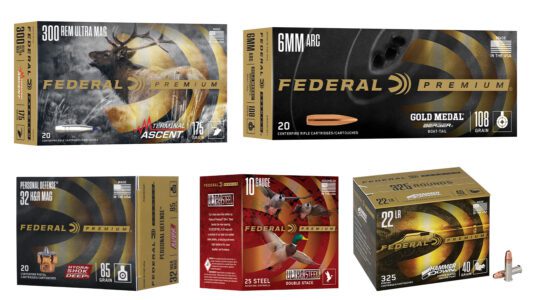
Helpful Strategy - Line extensions are an important component of a manufacturer’s product mix.
News Briefs - January / February 2026

There’s no question that new products are the driving force in this industry; they garner the most attention in the media, and they attract customers to retail outlets. But the industry has a helpful strategy up its sleeve to help keep retailers and consumers coming back for more—line extensions. Line extensions are add-ons to existing product lines. One important aspect of line extensions is they allow a manufacturer to update a product line with ideal timing—and often without a massive investment in R&D.
“Line extensions are very important to us,” says Dan Compton, Federal’s shotshell and rimfire product director. “The R&D investment in a line extension will vary greatly depending on what it is. For rimfire, most line extensions are additions to a product line that add a new bullet option (typically grain weight) or a cartridge, like adding .22 LR to our HammerDown product line designed for hunting with lever-action rifles, which first launched in just several centerfire cartridges only, and now has a rimfire option. For shotshell, most line extensions are additions to a product line that add a new payload weight, velocity, hull size, shot size, or gauge. Adding a new packaging option, like a new bulk pack option, is also considered a line extension.”
In essence, line extensions help a manufacturer strategically build on its offerings. Here, Compton cites the company’s approach with Federal Premium Ultra Steel. “In the first year [2024], we only released 3-inch 12- and 20-gauge loads. This represents a majority of what we know hunters prefer. In year two [2025], we added 3.5-inch 12- and 10-gauge loads to the family. Going forward, we will continue to add additional shotshell loads to round out the product line based on the evolving needs of our customers.”
Compton notes that the company could have launched 3.5-inch 12- and 10-gauge loads in the first year of Ultra Steel, but it wanted to first see how the initial product was received. That allowed Compton and his team to use the time and resources to focus on other product offerings for that calendar year. As beneficial as line extensions are, they aren’t automatic home runs. Occasionally, consumers won’t accept the extension. “There is always a risk of wasted time and cost if the extension isn’t truly needed,” says Mike Holm, Federal’s centerfire rifle product director. “If you make an addition to the product line too soon, you can make older, yet still great products seem outdated. Also, consumers may love the product as is, and now you have given them an excuse to evaluate other products.”
To Holm, the value of a line extension is an ability to “build on a lineup to stay current with consumer needs in a given product line or usage category. Doing so also allows us to evolve a current product line in order to elevate its performance, thus making it new again.” For example, Federal’s line extensions of Gold Medal Berger in 6mm ARC and Terminal Ascent in 300 RUM in 2025 played to those cartridges being in hot demand by hunters and shooters.
And though line extensions typically don’t command a large R&D budget, cost factors have to be considered. “A new bullet caliber within a current bullet product line can be a pretty straightforward development or very complex and time-consuming,” he says. For example, Federal’s line extensions of Hydra-Shok Deep in .32 H&R and .45 Colt each have their own bullets that needed to be designed and built from the ground up. In the shotgun arena, a new gauge may take a lot of R&D time. “It depends on how close it is to other products we do today,” says Compton. “New wads always take time to develop, test, and industrialize.” For example, it was not that simple to convert Federal’s Podium Wad in their High Over All competition target loads when they added 20-gauge line extensions.
According to Compton, go/no-go decisions “are driven by our product line managers in their respective categories. They will look at volume, potential revenue, and brand importance. If it looks good to us, we will put it on our product roadmaps and the engineering team will work from that. The roadmap will dictate the year in which we are looking to launch the product and gives them timing to prioritize resources.”