Stock Options
Wood rifle stocks aren’t going away, but a slew of more modern alternatives is fast gaining ground.
By Guy J. Sagi

It’s where cheeks weld, shoulders settle, and shots steady. For more than a century rifle stock options, most of them wood doppelgängers, performed those duties undeniably well, but modern versions break the mold with all-new material and adaptability tailored to a shooter’s needs, physique, and even taste.
Wood rifle stocks aren’t going away anytime soon, if ever. The appeal is undeniable, a testament to Mother Nature’s artistry and warmth. Enhanced by an oil finish on classic lines with checkered highlights it’s timeless. It doesn’t require fancy Monte Carlo or Mannlicher style to be a valued addition to any gun safe, but there’s a new generation of aftermarket masterpieces gaining traction.
Many are made from space-age polymer. Others feature fiberglass construction, metal (usually aircraft-grade aluminum), wood with features once considered impossible, carbon fiber, and even clever combinations of ingredients.
Business Opportunity
Most gun manufacturers today make their rifles available in a crowd-pleasing variety of stock configurations. They offer different colors, camo patterns, or features ideal for popular pursuits, including hunting, long-range shooting, or home defense.
Financial reality keeps the selection limited, however. Each version must appeal to enough enthusiasts to keep orders coming, inventory moving, and employees paid. A limited run designed for a specialized application could languish in a warehouse and tie up cash when it’s needed elsewhere.
Custom gunsmiths and boutique companies traditionally filled that void, creating heirloom-quality stocks and complete rifles using the actions of major manufacturers. The price tags were lofty and delays long. As a result, most owners considered themselves stuck with the weathered milquetoast stock that shipped with the rifle.
Those days are gone. Today companies that craft quality aftermarket stocks and chassis are thriving. Some offer cutting-edge designs built for those who demand the utmost in precision. Others give owners the opportunity to doll up an heirloom or modernize an old favorite that doesn’t deserve a gun-safe life sentence.
Business is brisk for these firms, for good reasons. Their products look great and perform. Lengthy waits are a thing of the past and installation is usually a simple, no-modification-required DIY affair. There’s a lot to like in what they offer.
Weathering the Storm
Aftermarket stock demand remains relatively steady, even during periods in which gun sales are slow. The primary customers, after all, are enthusiasts who already own a firearm that’s overdue for an upgrade.
One of the keys to maintaining a steady stream of orders in a crowded market, according to Dustin Knutsen, co-owner of Boyds Gunstocks, is expanding product lines. “Our newly released products always sell well,” he says. “So, we just keep working to make stocks for an increasing number of actions and making styles that people continue to like.”
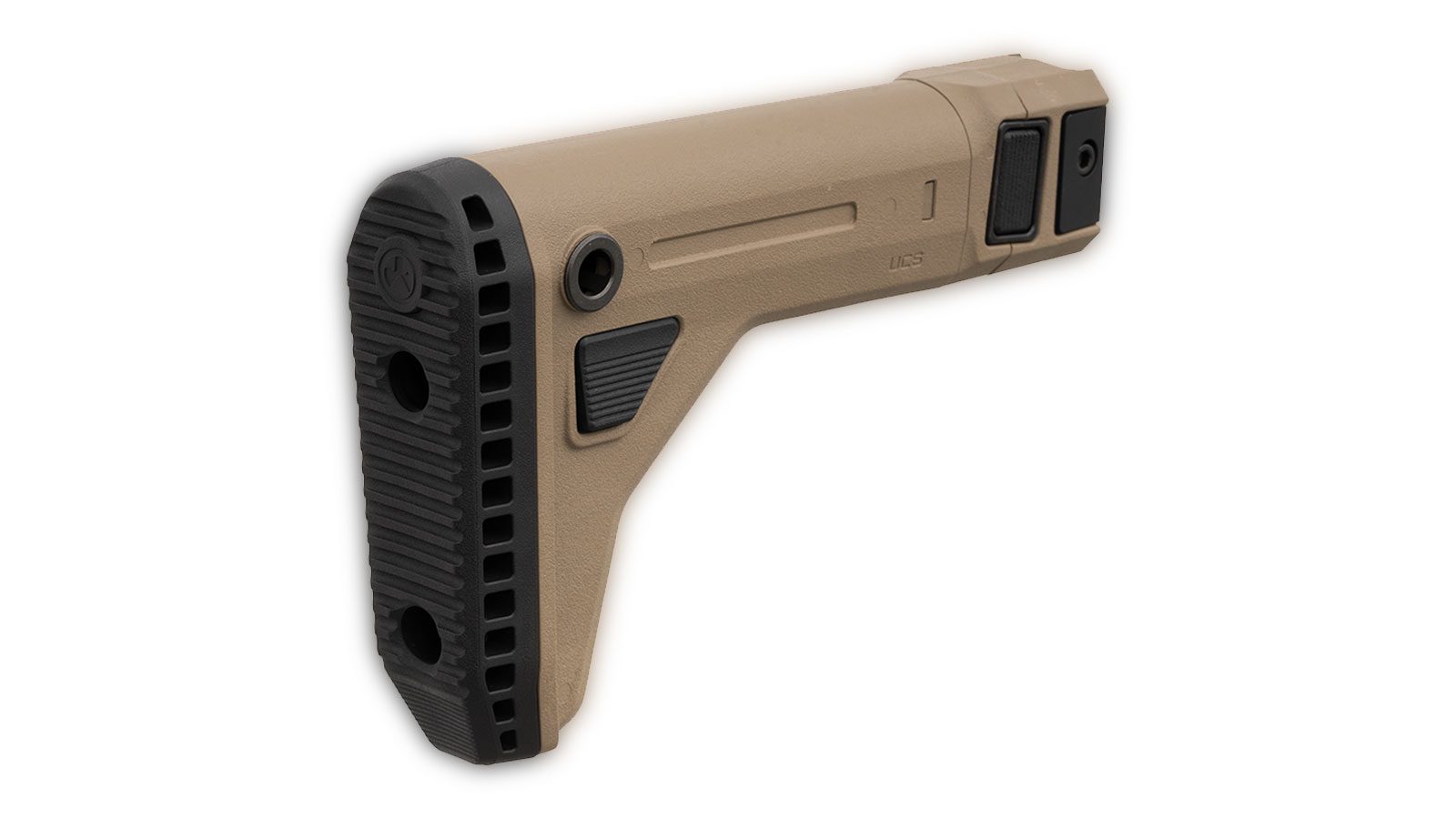
The same strategy fuels appetite for Magpul’s polymer stocks. “Our Hunter Lite stocks line is about to grow to three, and our new UCS stock for firearms has vertical Picatinny rails on the rear of the receivers. They’ve all been incredibly successful,” says Connor McKibbon, marketing coordinator at the company. “That said, the overall slowdown in the industry isn’t hitting us as hard as it sounds like it’s hitting some others.”
The approach hasn’t escaped Grayboe, which was established as a division of McMillan Group in 2016. It recently introduced The Core, which has a carbon-fiber or fiberglass body—depending on model—solidly anchoring a Universal Mini Chassis made from T6 6061 billet aluminum. The company will soon release a new Renegade 2, with five quick-detach points for sling mounting, optional Picatinny rail, and more.
McMillan Stocks, manufacturer of fiberglass and carbon-fiber stocks since 1973, added HLS camo to its line in early 2025. Five months later it introduced Drop-In-Ready stocks, a design that often eliminates the need for bedding on most precision rifles.
Modular Driven Technologies (MDT)—a Canadian firm established in 2009—quickly became one of the industry’s foremost when it introduced its aluminum TAC21 metal rifle chassis. The company is primarily renowned for models that feature aircraft-grade metal construction, but often employs a magnesium alloy and/or carbon fiber in variants reduce weight. It’s also not shy about using a polymer “skin” over an aluminum frame. The company today is an OEM supplier to major gunmakers, and its products are in use by military and law enforcement personnel. The firm’s rapid expansion speaks volumes for this specialized section of the industry.
In 2018 it opened an MDT USA warehousing and distribution operation in Washington state. Then, in 2024, assembly, manufacturing, and distribution duties consolidated in a larger Post Falls, Idaho, headquarters. The same year the company, which now offers magazines, bipods, soft goods, and more, released 44 new products. That pace shows no signs of slowing.
Factory-Direct Custom
One of the primary catalysts driving aftermarket stock sales is personalization, according to Knutson. “Having an adjustable length of pull, or a LOP, cut to your length is most in demand,” he says. “I think people are realizing the importance of a well-sitting stock to reduce recoil, better sight acquisition, and overall comfort while shooting.”
There’s much more to the customization, however, and it shows in available options. Many companies offer versions with Picatinny rail sections or M-LOK slots for fast tripod and accessory attachment, quick-detach points to easily alter sling reconfiguration, tool-free height-adjustable cheekpieces, and more. Improvements in ergonomics, comfort, and reliability are steady as well, but too often get lost in the headlines.
Magpul etched its name permanently into the firearm lexicon with the legendary performance and reliability of its AR magazines and furniture, but its bolt-action stocks have quickly gained an avid following. “When it comes to hunting stocks, the four stocks we created for the Ruger 10/22 are the most popular, primarily because our stocks provide so many options for that platform,” McKibbon says. “Our Hunter Stock line for Remington 700s (or any 700-pattern rifle), Ruger American, and the Savage 110 also have made their way onto a lot of hunting rifles in America. The combination of features and individual adjustability, along with a great price point compared to other aftermarket stocks, has made them very popular.”
The Evolution
Wood stocks were born, sort of, more than 1,000 years ago when someone in China stuffed gunpowder and gravel into a hollow wooden tube and touched it off. There’s no doubt it frightened neighbors, delighted kids, deterred foes, and launched an industry that flourishes to this day.
Metal and polymer rifle stocks are a more recent development, but still far from yesterday’s news. By World War II metal stocks were standard on several historically significant firearms. The M1 Paratrooper Carbine, for example, along with the M3 submachine gun (commonly called the “Grease Gun”), featured heavy-gauge steel wire for their stocks. The former’s version folded against the gun. The latter telescoped out for shouldering when necessary. Axis forces fielded the MP-40 with a similarly spartan stock, but its version rotated under the firearm when not in use.
The designs were logistically convenient and nimble in combat, but a far cry from modern iterations. Steel is heavy, and it rusts. Wire isn’t exactly stable on a shoulder. The concept was largely ignored after cost and manufacturing speed were no longer a priority. But something more promising was on the horizon anyway.
At about the same time, or shortly after, Stevens Arms (savagearms.com) took a giant leap by offering some of its .22-410 Combo rifles stocked with Tenite, a cellulose polymer made from soft wood. Unlike today’s synthetics it was renewable and had nearly the same feel as wood. Unfortunately, it warped badly with age and never caught on with gun owners. A few did serve as survival guns with the Army Air Corps, however.
Remington’s Nylon 66 was the first commercially successful rifle with a synthetic stock, Zytel Nylon 101 to be precise. It hit the market in 1959, continued in production until 1989, and is now considered a classic.
Fertile-minded gunmakers were far from done, though. In 1965 Brown Precision invented the fiberglass stock. Christensen Arms (christensenarms.com) unveiled the world’s first carbon-fiber rifle stock in 2003.
There’s no telling what’s next. The improvements in the past few years have been staggering, but shooters don’t always embrace new and improved. In fact, some seem to prefer the original.
Wood’s Comeback Tour?
Wood isn’t throwing in the towel. “A growing trend is people building ultra-traditional stocks out of walnut or maple with traditional checkering patterns,” Knutson says. “Thumbholes are always another popular choice for many people.”
MDT USA’s heavy-metal success is well documented, but even it has recently acknowledged how much shooters appreciate Mother Nature’s warmth. At the January 2025 SHOT Show the company unveiled its TIMBR CORE rifle stock, with an adjustable length of pull, checkering, aluminum micro-chassis, V-block bedding, and more in either wood laminate or walnut.
With more aftermarket stocks available today than ever before, successful manufacturers still find success by harnessing strategies that make their products and services distinct in a crowded market.
Corporate Magnetism
“Everything about our stocks and our business set us apart. Many colors and styles for many firearms, all built for the customer,” Knutson says. “They are not mass produced and set on a shelf waiting for a buyer. When we get a customer’s unique order it is sent to our floor and within a week or two it is shipped to the customer.”
Magpul’s mission focus is its key to success, according to McKibbon. “We don’t make products—stocks or otherwise—just because everyone else is jumping on the bandwagon of what’s hot at a given time. One of our core foundations is that we make what people need, not what they want. By doing the former, by nature, we supply the latter. Our product designs and features exist because they provide solutions to problems, so our products bring innovation where it’s lacking.”