

Selling Riflescopes
Today’s feature-laden riflescopes can pose a challenge for counter salesmen who haven’t stayed completely abreast of the latest developments. Here’s what you need to know to gain the sale.
By Wayne von Zwoll

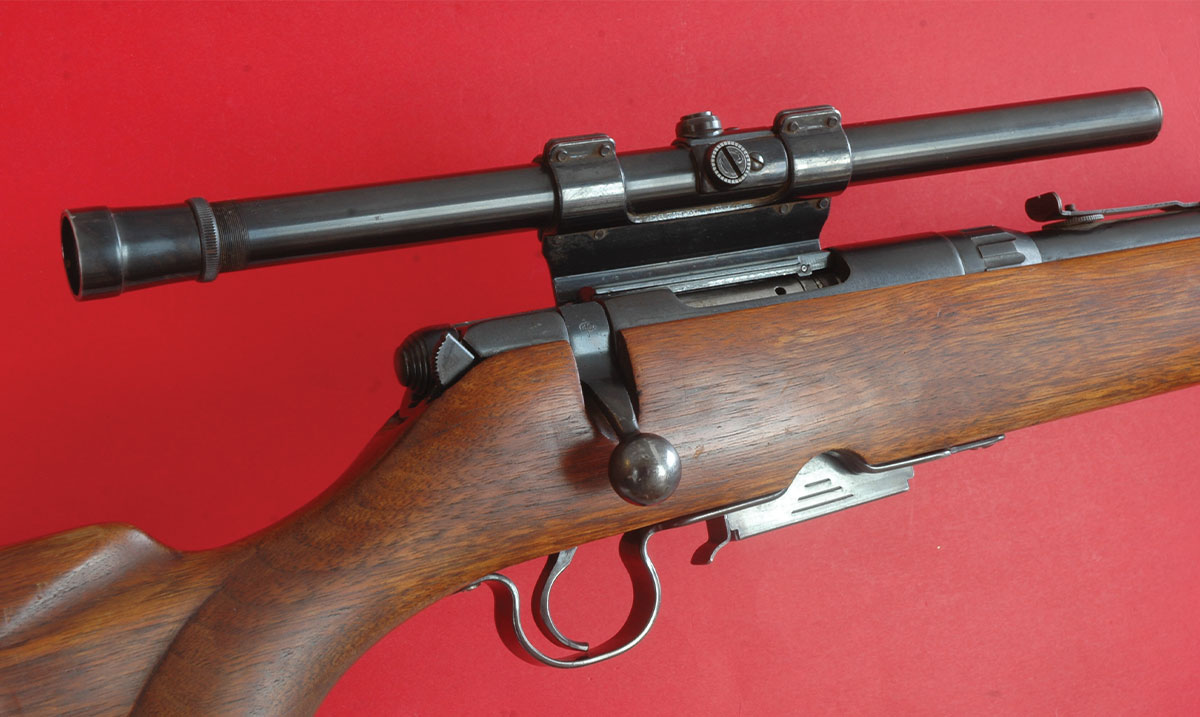
My second-hand Savage 340 bolt rifle in .222 wears a Weaver B6 scope. Both date to the 1950s. Well into its 12-year run, the B6 sold for $10 with a stamped-steel mount. Front lens diameter in the ¾-inch tube was half an inch (12.7mm); dusk fell early through a 2mm exit pupil. Recoil quickly ate the two inches of eye relief.
In Simpler Times
The B6 followed a series of Depression-era ⅞-inch scopes that trailed young Bill Weaver’s 3x 330, designed and built in a small Newport, Kentucky, shop in 1930. Notable among this clan: Rudolph Noske’s 2½x and 4x (1930-1939) and Lyman’s 2½x Alaskan (1939-1957). The close of WW II released to the industry Zeiss’s discovery that magnesium fluoride lens coatings increased light transmission. In 1947 Weaver gave its K-series scopes 1-inch (25.4mm) tubes. The next year Marcus Leupold replaced air in scopes with nitrogen gas to prevent fogging.
As 1-inch alloy tubes replaced steel, Kollmorgen, a New York optics firm, peddled 26mm scopes under its name, then in the 1950s as Stiths. After Kollmorgen sold in 1959, those scopes became Redfield Bear Cubs. That year, Swarovski announced its first 4x riflescope, challenging Weaver’s top-selling K4.
But grass grows tall over the graves of fixed-power scopes. Long after Zeiss pioneered variable power, U.S companies took it up—Weaver with a 2¾-5x scope in 1950, Leupold and Redfield with 3-9s in the early 1960s. When Swarovski introduced a variable scope in 1965, its U.S. sales vaulted 48 percent. That tale repeated itself industry-wide. By 1997 Swarovski’s 4x and 6x models together would account for only one percent of its scope sales.
Bigger is Better
A trend to high magnification urged adoption of 30mm tubes. Big erector lenses boost resolution. Alternatively, standard erector lenses get more room to move, “adding clicks” to windage and elevation (W/E) dials. A 30mm bonus: broader power ranges. “Three times” ranges (top magnification three times the bottom) gave way to four-, five-, six-times. Up-sized front glass to boost brightness increased weight, bulk, and price. But a “bigger is better” mantra prevailed. Such scopes outsold the trim 12-ounce 2.5-8x36 Leupold and 3-9x36 Swarovski.
In 1985 the Kahles Helia led a shift to 30mm 1½-6x24 scopes. This was a big leap from 1-4x20 variables serving close-cover deer guns and “stopping” rifles in Africa. The area of a 24mm objective is much greater than that of a 20mm. Six-times magnification made scopes without front bells practical for all-around hunting. A 1-6x24 at 4x yields a 6mm exit pupil (24/4), about the eye’s dilation limit in fading light. At low power the field is stadium-wide; at 6x a deer 300 yards away appears as big as one seen with the naked eye at 50. Despite greater average weight, 1-6x scopes soon ate into demand for 13-ounce 2-7s.
What’s Important
When peddling scopes, a list of features that sell and/or improve utility makes sense. Fully multi-coated lenses (every lens surface coated to curb reflection and refraction, which can steal four percent of incident light) are all but standard. Anti-abrasion coatings, like Leupold’s DiamondCoat, protect exposed glass. Hydrophobic treatments, such as Zeiss’s LotuTec, bead water for clear aim in rain.
Crisp, repeatable W/E adjustments bring confidence in your zero and in changes you might make afield. A turret-side focus/parallax dial nixes parallax error—reticle displacement as your eye moves off the scope’s axis. Parallax error is hard to see at low power and is moot if your eye is on-axis. High-power settings show small errors that the dial can correct as it refines target focus.
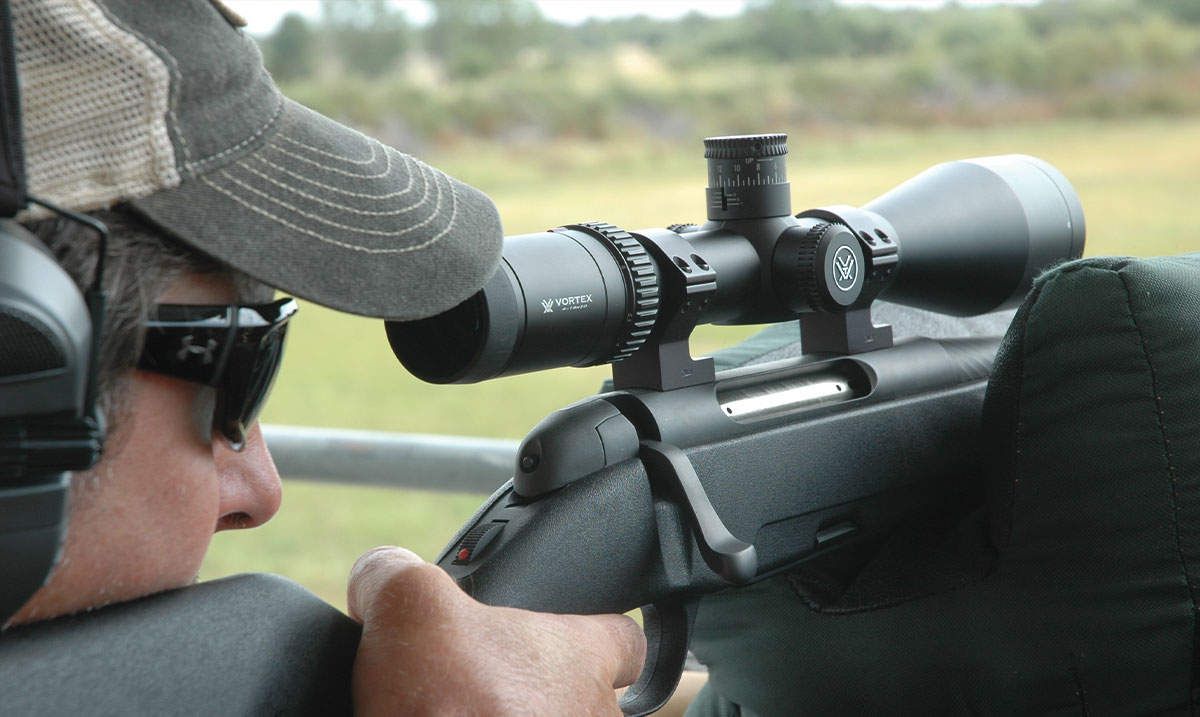
A fast-focus eyepiece focuses only the reticle and once set for your eye needn’t be changed until age affects your vision. The traditional fine-thread eyepiece with lock ring works fine but is about dead.
Large objective bells (say, 50mm instead of 42mm) yield brighter sight pictures only in dim light at high magnification. Front lens size has almost no effect on field of view, which is determined by ocular lens diameter, magnification, and the scope’s internal design.
An illuminated dot can help on dark targets and moving game against mottled backgrounds. Best reticles for hunting are simple. Spiderwebs of tics, dots, and secondary lines clutter and confuse. Standard plex reticles, with the German #4 and Burris’ practical Ballistic Plex, excel afield. Most reticles lie in the rear or second focal plane (SFP) of variable hunting scopes. Their dimensions appear unchanged during power changes. Many long-range target shooters favor first-focal-plane (FFP) reticles. These appear the same in relation to the target whatever the power, so can serve as rangefinders at any setting. They don’t move, so don’t impose aiming error. Liabilities: they appear thick at high magnifications, which can hinder aim on small, distant targets. At low power — best for close, fast shots — they’re thin and hard to see quickly.
Insist on 3½ inches of eye relief. Check variables at low and high power, because ER can shrink as you dial up. Measure “free tube” to ensure rings put the scope where you want it, relative to your eye.
A load-specific or “trajectory-matched” elevation dial permits “dialing to the distance” so center aim yields a hit at any range—a fast, accurate correction. Now many scope makers offer one such dial at no cost with a scope purchase. Just name the factory load or the handloaded bullet (with muzzle velocity). A load-specific dial is arguably one of the most useful additions to a hunting or target scope.
New and Notable
Myriad new or updated riflescopes defy roundups. Herewith, a couple of promising introductions from familiar sources.
Burris
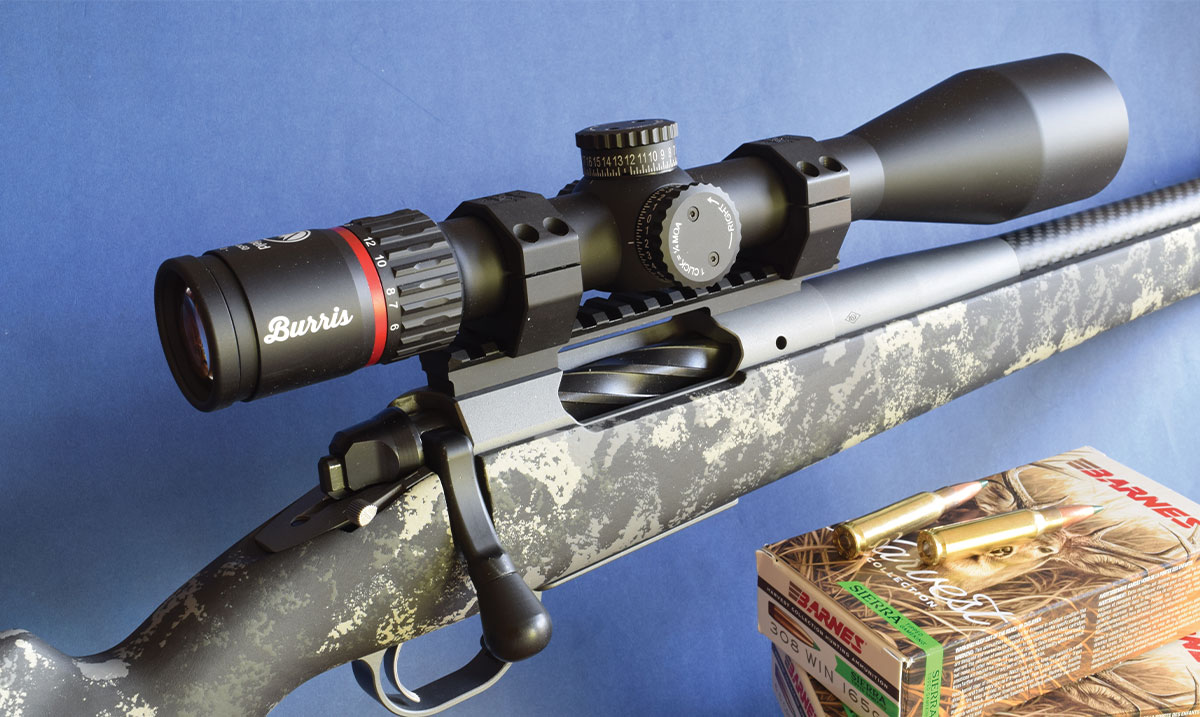
Priced from $160 to $500, the 2-8x35, 2.5-10x42, 3-12x42, and 4-16x50 fifth-generation Burris Fullfield scopes have bright lenses in 1-inch tubes (30mm for 12x56 and 6-24x50 models). Exposed W/E dials are easy to swap for capped or load-specific dials. The Veracity PH line comprises 30mm 2.5-12x42, 3-15x44, and 4-20x50 scopes with FFP lighted reticles, focus/parallax dials, and heads-up displays. SRPs: $1,100 to $1,300. For long-range shooting, the 34mm $2,400 XTR (3.3-18x50 or 5.5-30x56) is of the digital age, with electronic access to ballistic data. A new 4-20x52 Eliminator 6 has a trim, “standard scope” profile. At 30 ounces, it’s lighter than its forebears and, at $2,500, less costly. It ranges to 2,000 yards. Bluetooth-mined information lights an aiming dot.
Leupold
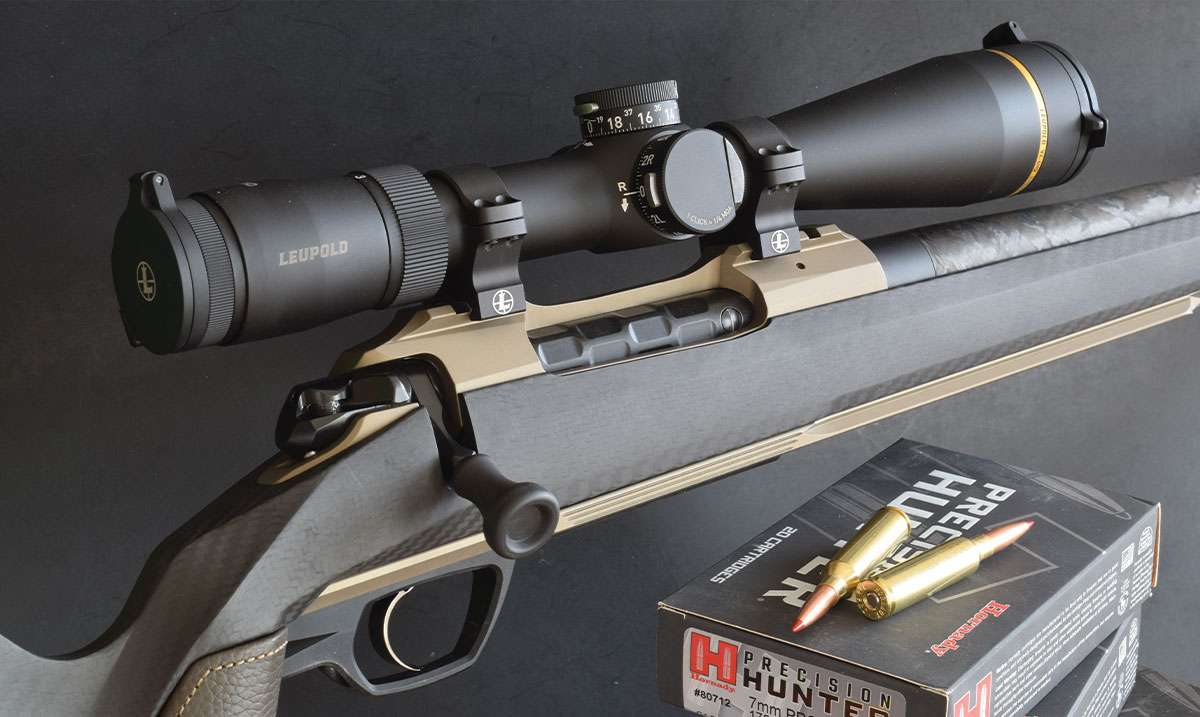
The VX-6HD series of 30mm Leupold riflescopes has added a Gen 2 subset: 1-6x24, 2-12x42, 3-18x50, and 3-18x56. An outlier, the 4-24x52 Gen 2 has a 34mm tube. Common features: Guard-Ion lens coatings, a SpeedSet elevation dial switchable without tools, “Precision Side Focus” that also eliminates parallax, choice of four SFP reticles, and automatic illumination shut-off. Prices of $2,000 to $2,600 will send some shoppers to the VX-5HD Gen 2 series (a 3-15x44 at $1,200) or the VX-3HD (a 4.5-14x40 at $600). A VX Freedom 3-9x40 lists for $400. All have the Custom Dial System (CDS) option, in which Leupold ships a free load-specific elevation dial for “dial to the distance” convenience.
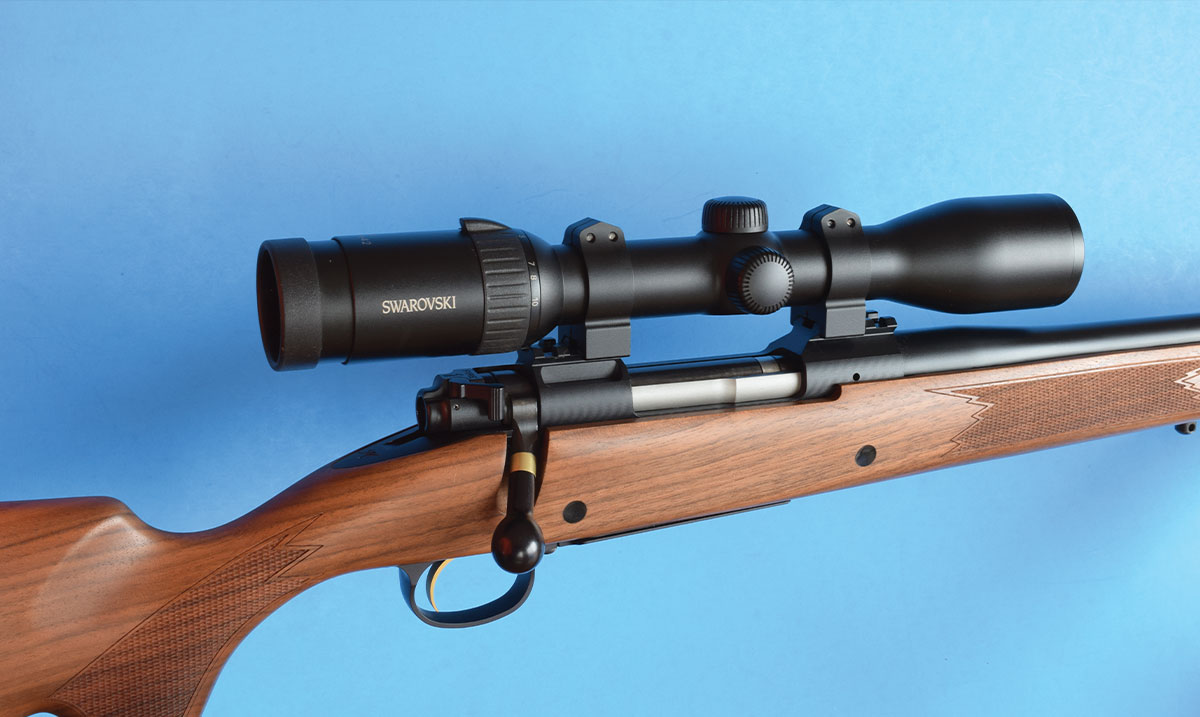
Swarovski
Austria’s famous optics firm has fielded three new Z5+ rifle-scopes. The 2-10x42, 3.5-18x50, and 3-25x56 Z5+ have 30mm tubes, not the 1-inch of Z5s. That diameter change helps boost W/E adjustment range significantly. Turrets accept “Personalized Ballistic Rings” for designated loads. The 3.5-18x and 5-25x boast focus/parallax dials and glass-etched lighted reticles. I’m sweet on the 15-ounce 2-10x42. It has superior optics, clean, uncomplicated design, and peerless function. Truly a great hunting scope. Z5+ features add 1¼ ounces to the weight of Z5s and roughly $100 to SRPs. The 2-10x42 starts at $1,649, its mates at $1,869 and $1,969. For long-range buffs, Swarovski has a Z8i 5-40x56.
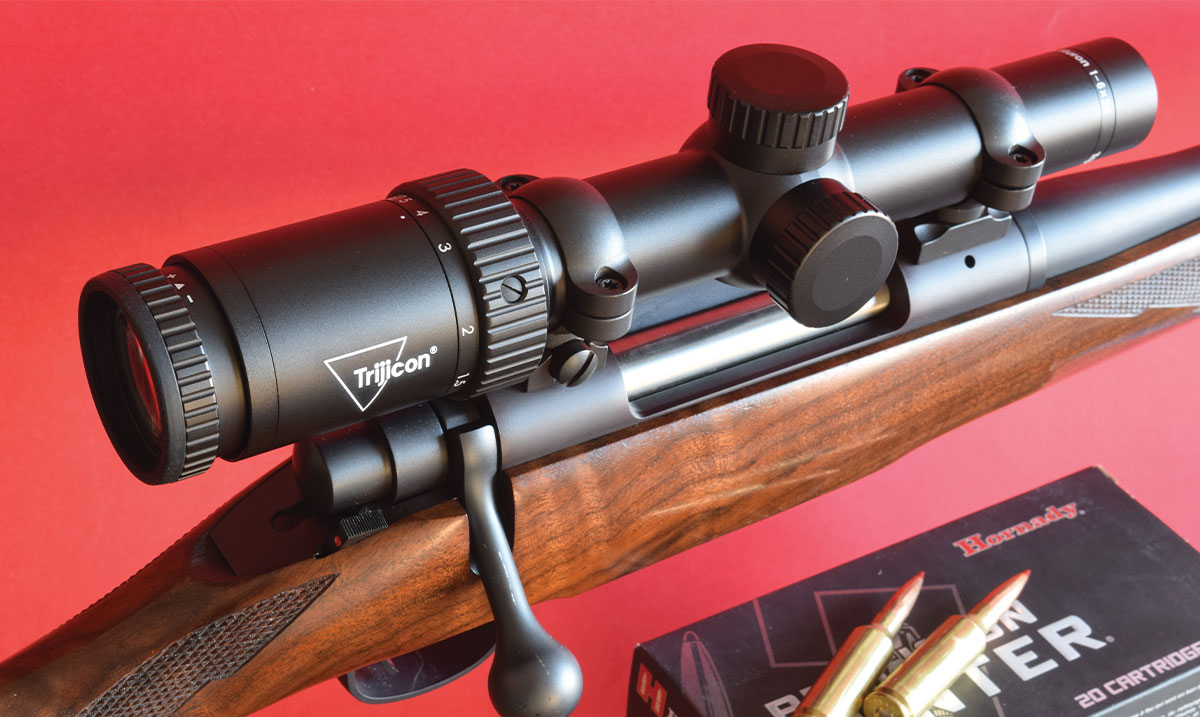
Trijicon
The Huron and Ascent scope series from Trijicon recently gained 30mm 1-6x24 and 4-16x50 entries. The Hurons are satin-finished. Ascent scopes, which the company notes pass military muster, have matte finish. The Huron offers a choice of Trijicon’s “Hunter BDC” reticle, a plex, or a German #4. The Ascent has a Ballistic Drop Compensating (BDC) crosswire. All reticles are SFP. Either 1-6x24 scope weighs 18 ounces; either 4-16x50 scales 24. Prices for the new Hurons and Ascents are identical, too: $735 and $985 for the 1-6x and 4-16x, respectively.