

Just Getting Started!
Three decades of EOTECH are simply a preview of future excellence.
By Brian McCombie

Best-known for its high-tech Holographic Weapons Sights (HWS), EOTECH has spent the last several years diversifying into magnified scopes, micro red dots, night-vision and thermal systems, and on-gun laser devices. In January 2026, for example, the tech manufacturer launched two new non-HWS products: the OGL C laser sight and the VUDU 4-12x36 first focal plane riflescope. The VUDU 4-12x36 represents the next scope in the VUDU “shortie” line, a very compact optic at just 7.1 inches long that punches way above what its size might suggest. It is “next,” in that the VUDU 3-9x32 was EOTech’s original extremely compact scope, debuting in 2025.
The OGL C was another follow up, the new civilian version of the OGL (On Gun Laser). Mounted on the rail of a rifle, the OGL C combines visible and IR lasers for extremely fast target acquisition. The original OGL dropped in 2023 for law enforcement and military users.
These two new product introductions followed a good deal of important work on the military/defense side of the marketplace in 2025. This included EOTECH winning a contract for the Missile Defense Agency Scalable Homeland Innovative Enterprise Layered Defense (SHIELD) indefinite-delivery/indefinite-quantity with a ceiling of $151 billion. In addition, in a strategic move to expand its role in the defense technology ecosystem, EOTECH acquired VK Integrated Systems (VKIS), a Tennessee-based developer of advanced weapon electronics and battlefield networking solutions. Meanwhile, the company continues to improve its HWS offerings with products like the EXPS3-DCR, featuring EOTECH’s Danger Close Reticle.
“The future is exceptionally bright for EOTECH,” says Joe Caradonna, EOTECH’s CEO. “We are aggressively advancing our core weapon optics to reinforce and extend our leadership position while simultaneously scaling into high-growth categories—including digital systems, advanced sensors, counter-UAV technologies, and integrated, connected soldier systems—where we are uniquely positioned to emerge as a global leader in the near term.” That’s a tremendous amount of activity. Many a company would take a long breather in a business sense, pull back, and see market reactions to all the new. But, clearly, EOTECH is just getting started.
In The Beginning
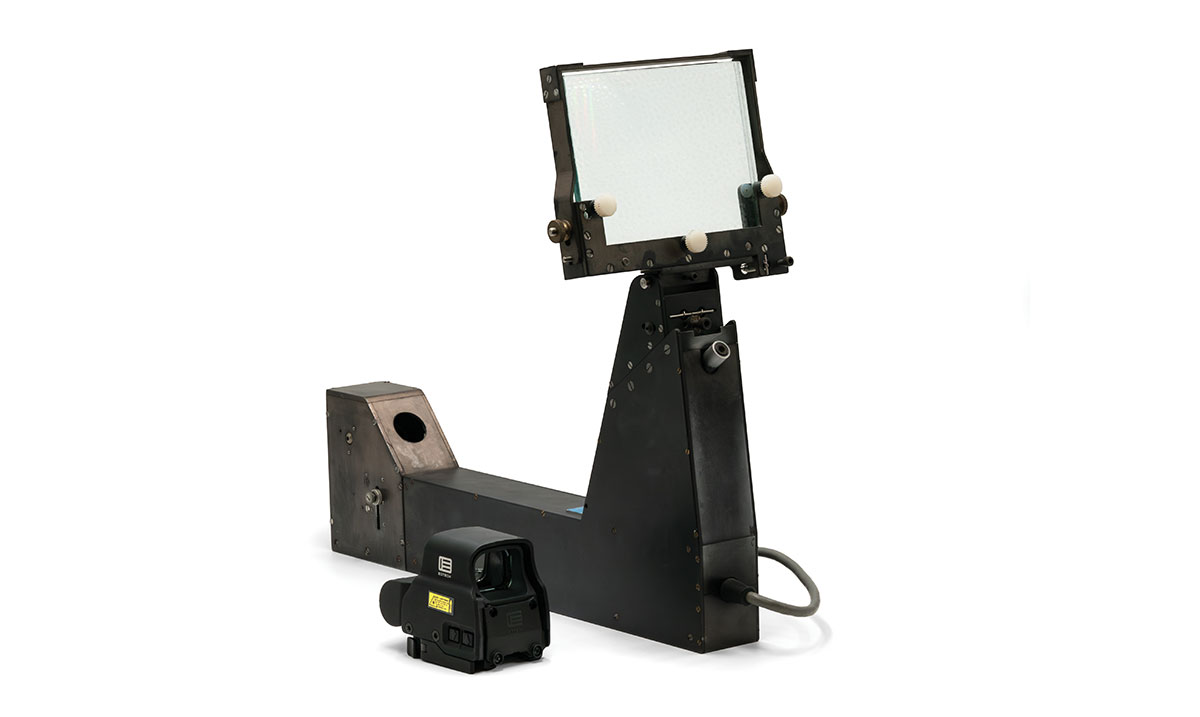
The foundation of what eventually became EOTECH goes back to 1972, when the University of Michigan created the Environmental Research Institute of Michigan (ERIM) in Ann Arbor. A stand-alone non-profit organization, ERIM received federal funds to perform military and environmental research on developing remote sensing, radar, and holography technologies.
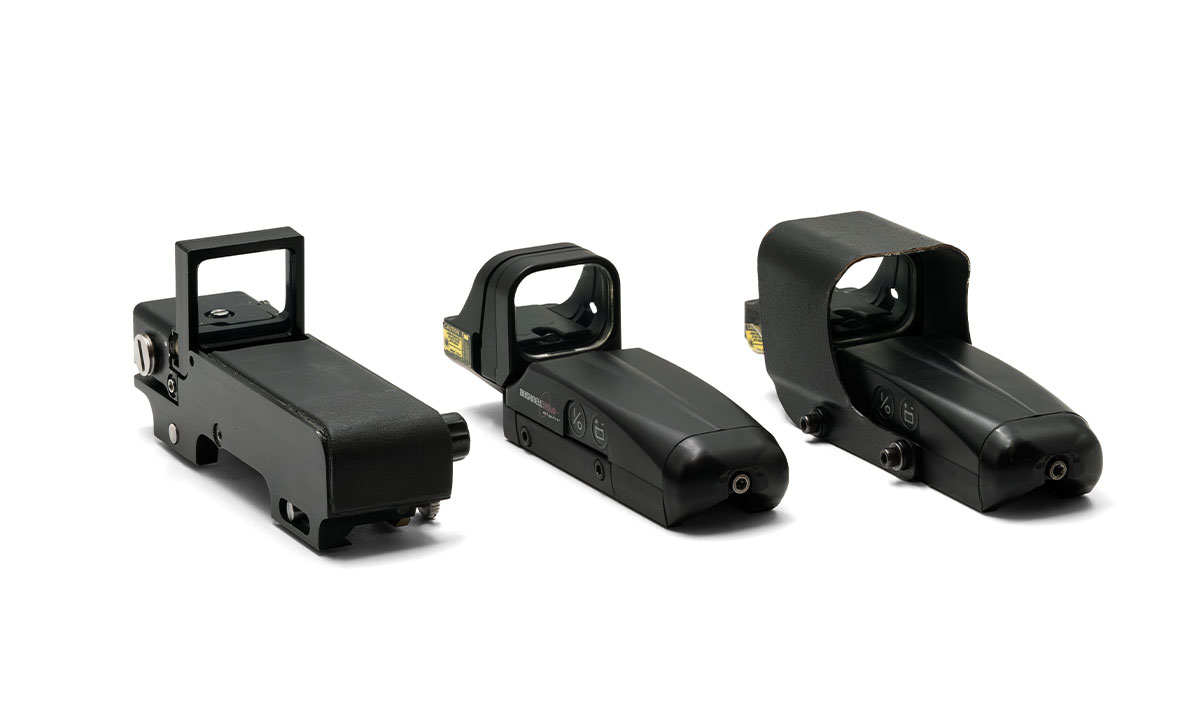
Dr. Anthony Tai, one of ERIM’s original holographic experts, would later become an original investor in EOTECH, serving as the company’s chief technology officer. Van Donahue was another ERIM staff member who later invested in EOTECH. He operated as the company’s president of sales and marketing. It was Donahue who worked with optics maker Bushnell years later to create EOTECH’s first HWS. He also managed the company’s law enforcement and military markets.
Holographic research was taking off, and Tai and Donahue saw many potentials in the technology. In 1986 ERIM presented holography weapon sight prototypes to the U.S. Army for use with helicopter gunships and anti-aircraft artillery. The Army didn’t end up going forward with the prototypes, but it was clear that holographic technology was gaining a great deal of interest.
That tech produces a three-dimensional visual presentation. Because it relies on lasers and mirrors, both reticle and target are viewed simultaneously, with the reticle cutting a very sharp, clear image. Using a holographic sight, a shooter maintains focus on both reticle and target without shifting their focus back and forth. Result? A faster, more intuitive aiming process, enhancing target acquisition in any situation.
Next Steps
“The Holosight provided quick target acquisition due to its 1X wide field-of-view and undetected parallax,” says John Bailey, EOTECH’s vice president of marketing. “It also featured switchable reticles.”
The U.S. military was quick to pick up on the great potential in the HWS for our warfighters, but tasked the company to build a more rugged HWS for testing. EOTECH did just that and, after a number of prototype units tested, by 2001 U.S. Special Operations (USSOCOM), select elite Army units, and the U.S. Marine Corps chose EOTECH HWS as their preferred close-quarter combat optic.
Today, EOTECH produces 10 standard HWS units available with various reticle options and offers five HWS-plus-magnifier pairings. In 2013, EOTECH sold its one-millionth HWS. The total number today is much greater.
Never Satisfied
The EOTECH 68 MOA ring is integral to the HWS systems and their great success. Engineered for speed, the reticle’s large outer circle is instantly visible, allowing shooters to quickly center their sight picture. At the same time, the circle’s four hash marks intuitively guide the eye straight to the 1 MOA dot. This design makes it one of the fastest reticles on the market for rapid target acquisition at close range.
Never satisfied with past successes, EOTECH even did the 68 MOA speed ring one better with the recent introduction of the EOTECH EXPS3-DCR HWS. Zeroed at 50 yards, the EXPS3-DCR delivers point-of-aim, point-of-impact accuracy at common defensive distances while still providing hits out to nearly 200 yards. But below the dot and at the open bottom of the speed ring sits a small chevron. With the center dot’s 50-yard zero, the top of the chevron will put you dead on for a target at seven yards.
That’s a danger-close distance. That chevron can make all the difference in a tactical situation. The ballistic reality is that with a rifle and HWS zeroed at 50 yards or even further, a very close shot will go low. When I reviewed the EXPS3-DCR, the seven-yard shots using the center dot were anywhere from 2.5 to 3.5 inches low. Using the chevron? Right on my target. Up close, mid-range and farther way, a shooter is ready for all three distances using the EXPS3-DCR.

Expanding Markets
EOTECH further expanded its market reach several years later with the second focal place VUDUX line up of riflescopes.
Next, the company went “short” with the second focal plane VUDU 3-9x32. The optic came in at an amazing 6.8 inches in length and weighed just 16 ounces. Yet, the little guy provided all the magnification of its longer, heavier brethren; it also featured .25 MOA capped turrets, a rotary-illuminated reticle with 10 brightness settings, and was fog-, water-, and shock-resistant.
The 4-12 features milrad adjustments, an illuminated reticle with 10 brightness settings, and the same XC high-density, low-dispersion multi-coated glass as its predecessors. The optic’s mounting interface is another important feature. To minimize the overall length, EOTECH reduced the tube area typically used for mounting rings. Instead, a machined interface located at the bottom of the scope will adapt to the included EOTECH mount or any aftermarket mini-ACOG mounts, and mount directly on a mil-standard rail.

For my money, these super-short riflescopes are among the best magnified optics for lever actions and AR-15 platform rifles, as the compact design of the scopes very much compliments the compact realities of these two carbine types.
Other notable firsts include 2022’s introduction of the EFLX Mini Reflex Sight for both professional and personal use, the company’s first foray into an LED-based pistol sight, and the aforementioned OGL (On-Gun Laser), which debuted the very next year.
For a number of years EOTECH sold the L3 ATPIAL (Advanced Target Pointer Illuminator Aiming Laser) to law enforcement, a lightweight, easy-to-use aiming system with integrated infrared and visible aiming lasers as well as an infrared illuminator. This was the forerunner to the OGL.
For some background, EOTECH was purchased by L-3 Communications in 2005 (now L3Harris), one of the world's largest defense contractors. But L3 Harris sold off its position in EOTECH in 2020. Currently, majority ownership is with Koucar Management.
“When L3 divested, there was still a high demand for a quality laser and there were also new laser opportunities for both U.S. and international military,” says Bailey. “We also saw a solid demand in the consumer market with other brands and felt we could produce a better system.”
That system was the original OGL, designed to operate with an HWS optic. The new OGL-C is currently making inroads into the civilian tactical market.
What’s next for EOTECH? Hard to say for sure. Yet, it’s obvious EOTECH will continue to push up against and then beyond our current technological boundaries, with products for the consumer and LE/Mil markets that will work very intuitively, will overcome field conditions, and will get the job done.

Don’t Call it a Red Dot!
Red-dot optics use an LED light source to project a dot or reticle onto the rear of the lens. The dot, then, is a fixed point between the shooter and the target. Given this, the eye of a shooter must focus back and forth from the dot to the target, then target back to the dot.
However, a holographic sight employs a tiny laser, a mirror, and a collimating reflector to create a tiny hologram, a three-dimensional image. In this case, that image is the speed ring reticle.
Another important difference: even when the sight window is partially shattered or obscured by snow or mud, the HWS will keep functioning and delivering pinpoint accuracy. The red dot? It’s done.