The Technological Advantage - Vortakt Barrel Works takes gun barrel design and manufacturing to new levels.
By Christopher Cogley
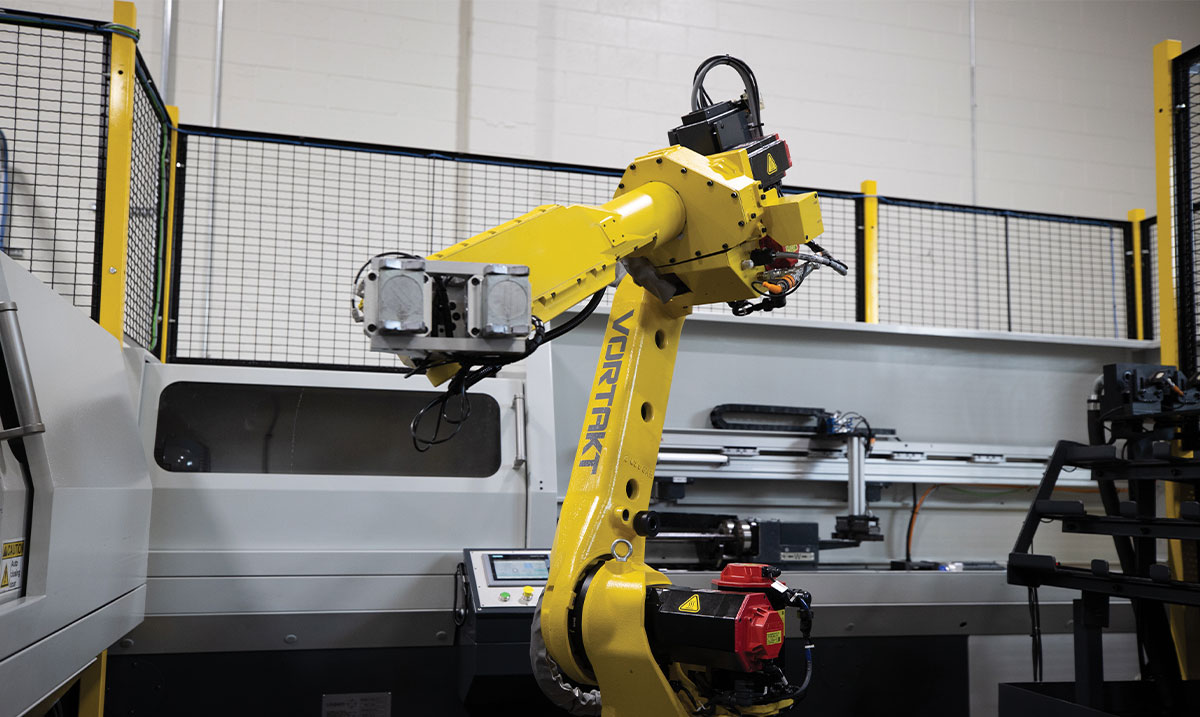
Collaborative robots, also known as cobots, help automate repetitive manufacturing tasks while working alongside employees. This allows skilled team members to focus on higher-value work that drives quality and productivity.
There used to be an adage that said you can have quality or you can have quantity—but you can’t have both. With the ability to craft high-quality gun barrels at almost any scale, however, Wisconsin-based Vortakt Barrel Works is changing that age-old-adage and giving gun manufacturers the quality they expect in a barrel and the quantity they need to keep up with market demand.
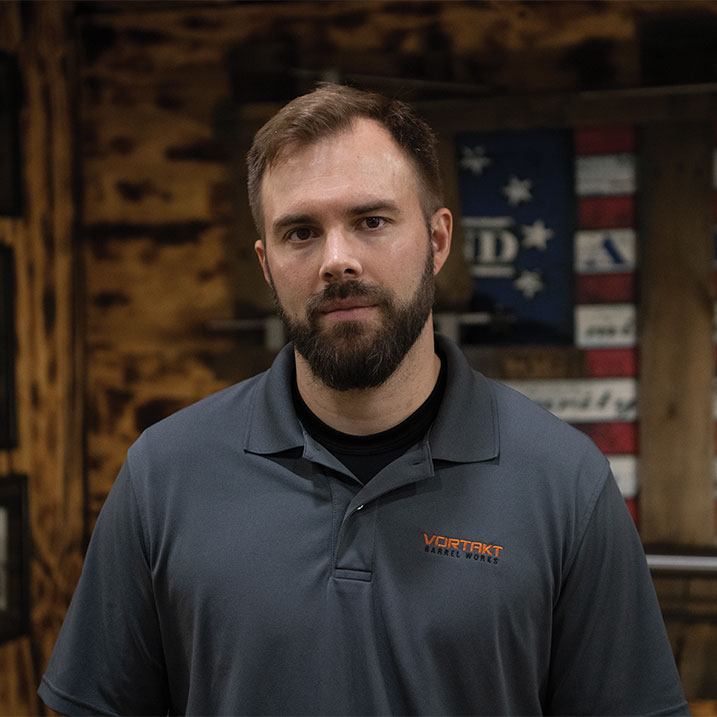
“Our goal is to meet our OEM clients where they’re at,” says Chad Weister, managing director at Vortakt. “We want to give them a high-quality barrel that’s made exactly to their specs, and we want to be able to give them the quantities they need—no matter how big.”
Vortakt can accomplish this mission because they don’t just implement new technology; they embrace it.
“Anywhere we can use technology to make a better barrel, we’re going to do it,” Weister says. “And because of automation, we can scale at a pretty incredible rate while maintaining a level of precision that’s unmatched.”
They can do this is because they implement arguably the latest, and most advanced, barrel manufacturing technology in the marketplace.
“When you have a customer that wants five thousand barrels a month, you need the equipment to handle it,” Weister says. “We can do that because our facility is the most advanced barrel manufacturing facility in the world.”
The reason he can make such a bold claim is because the machines that Vortakt uses to make its barrels are designed and manufactured by Vortakt’s sister division, Unisig. “Because we’re connected to Unisig, who are making the equipment, we get access to the most advanced technology before anyone else,” Weister says.
This relationship also allows Vortakt to go back and provide real-time feedback on how to update the design of the machine to meet a customer’s unique specifications.
“Because we’re an engineering-focused company, we find solutions to problems,” Weister says. “You need to understand the product you’re manufacturing, and the equipment used to make it is a critical part of that.”
When Vortakt first got into business, it almost exclusively focused on providing OEM firearm manufacturers with barrel blanks. “The problem we ran into is that a lot of our would-be customers didn’t have the machines or capabilities to contour, chamber, and finish the barrel blanks,” Weister says.
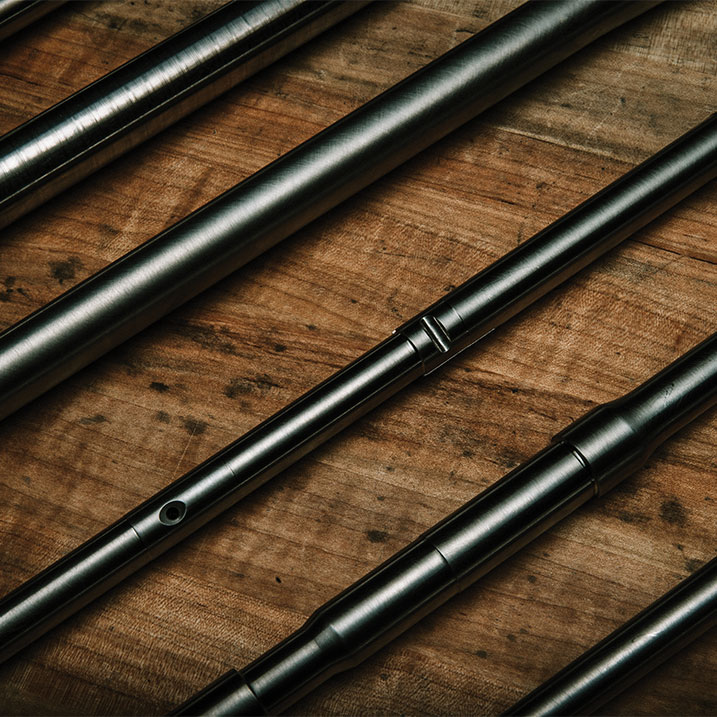
With continual improvement and significant investments, Vortakt acquired the equipment needed to provide client solutions based on their finishing needs. This might be a drilled, reamed, rifled, and stress-relieved barrel blank, a semi-finished barrel with exterior profiling, or a chambered and contoured finished barrel.
“We start with the customer’s drawing, then determine how to translate that into a repeatable process capable of producing high-quality parts at volume,” Weister says.
Vortakt designs most of its tooling in-house. Its engineers design custom solutions and work closely with tooling manufacturers to ensure the tools perform to the exact specifications required by each OEM. This collaboration allows Vortakt to configure its machines for unique applications while maintaining the efficiency and reliability required for high-volume production.
“Once you set up the machine correctly to meet the specifications you need, that machine is doing the exact same thing time after time,” Weister says. “The quality of the product doesn’t change.”
The operation isn’t entirely automated, however.
“There are some things you can automate, and there are other things you still need to do manually,” Weister says. “But there are certain aspects where we’ve found that automation produces a better and more efficient result than doing it manually.”
To help ensure that the machines are consistently achieving the quality products they’re designed to output, Vortakt builds in “inspection intervals.” At these points, the products are inspected by a trained machinist who makes sure that the machine continues to make the products to the exact specifications of the original drawing.
“Those quality gates are important,” Weister says. “Having multiple layers of inspection goes a long way toward making sure the part is exactly like it’s supposed to be.”
The type of quality and scale that Vortakt has achieved isn’t just about having the right equipment to do the job; it’s also about knowing that equipment well enough to make sure that you can respond quickly if something goes wrong.
“We check every machine at every shift change, every day,” Weister says. “Automation delivers exceptional consistency, but if a process parameter, tool condition, or program is off, it can produce a lot of bad parts very quickly.”
At the start of every shift, team leads verify tooling, process parameters, and machine performance to ensure everything is running correctly. That human verification confirms that tolerances and output continue to meet the exact specifications of the original drawing. The discipline is reinforced by structured preventive-maintenance schedules, routine machine inspections, and ongoing quality checks designed to keep equipment performing at its highest level.
“Another factor that significantly improves up time is our quick access to the engineers who built the machines and the service technicians who work on them every day,” Weister says. “They can diagnose issues quickly and resolve problems without waiting for outside service.”
Between the latest machine technology, automation, and expert engineering and machinists, the result is a Vortakt barrel that performs exactly as designed.
“We’re really proud of what we do,” Weister says. “It’s always about the product first. We believe that if we make good barrels, success for the company will follow. And so far, that’s worked out well for us.”
It’s also worked out well for all those people who are fortunate enough to have Vortakt barrels on their pistols and rifles.